Bigger Stage, Sharper Practice.
Mitratech was a different kind of challenge. Larger products, higher stakes, a disparate portfolio in need of harmonization. The instincts I had sharpened at Circa still applied, the scale demanded something more.
Mitratech had grown largely through acquisition. It was a strength; a broad portfolio of products serving compliance, risk, legal and HR teams across the enterprise. It was also a design challenge. Each product had arrived with its own visual language, its own patterns, its own assumptions about how users should move through it. Taken individually, each made sense. Taken together, they told the story of a company that had grown faster than its experience had.
Joining the Platform and AI team gave me the mandate to change that. Brand harmonization at the portfolio level is less glamorous than it sounds. It means making hundreds of small decisions consistently, building consensus across product teams who each have their own priorities, and holding a vision of coherence steady while the day-to-day work pulls in every direction. The north star was simple: a user moving between Mitratech products should feel like they never left.
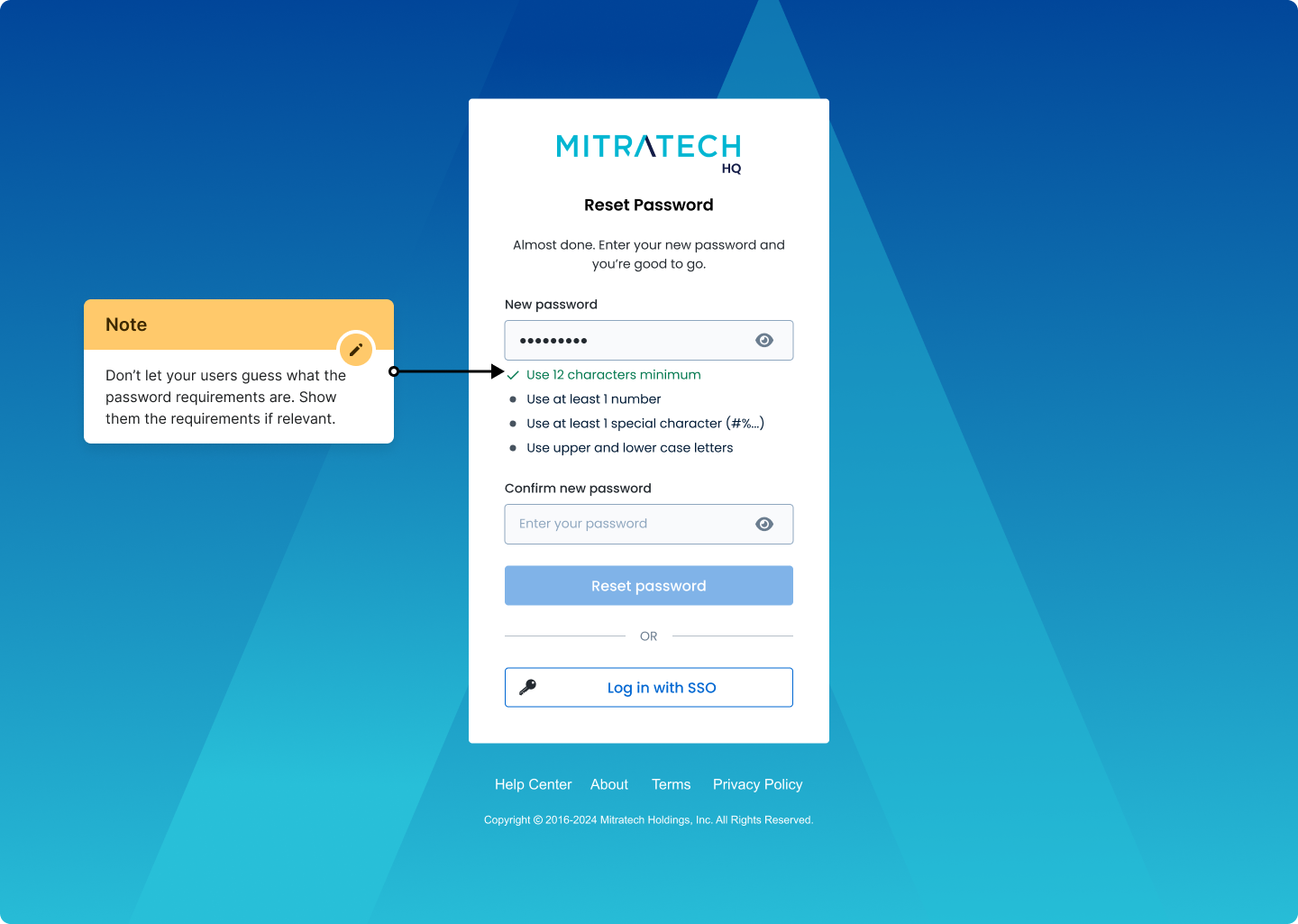
We started with our users’ most frequent request, updating all of our products’ log-in procedures to facilitate seamless SSO. In addition to the components themselves, my design team created easy to follow guides and documentation which helped other design teams to replicate the look and feel we were targeting. It also helped them to understand our design thinking process, to better align their work with ours moving forward.
AI accelerated what would otherwise have taken years. By introducing AI-enhanced design tooling into the practice, we freed designers from the repetitive groundwork of adapting components and auditing inconsistencies, redirecting that time toward the higher-order decisions that actually required human judgment. The result was a 22% lift in customer satisfaction and a 35% increase in platform adoption, evidence that coherence, at scale, is far more than an aesthetic concern. It’s a product strategy.
Unified by Design.
Design systems only work if designers can actually use them. That sounds obvious. In practice it is surprisingly rare.
When I arrived at Mitratech, Elevate — the company's design system — was a well-intentioned framework operating under a familiar set of constraints. Designers worked in Figma. Engineers worked in code. The handover between the two was a translation exercise that ate time, introduced inconsistency, and created friction that neither side had signed up for. Designers submitted specifications and waited. Engineers interpreted what they could and asked questions about the rest. The gap between design intent and shipped product was wide enough to matter.
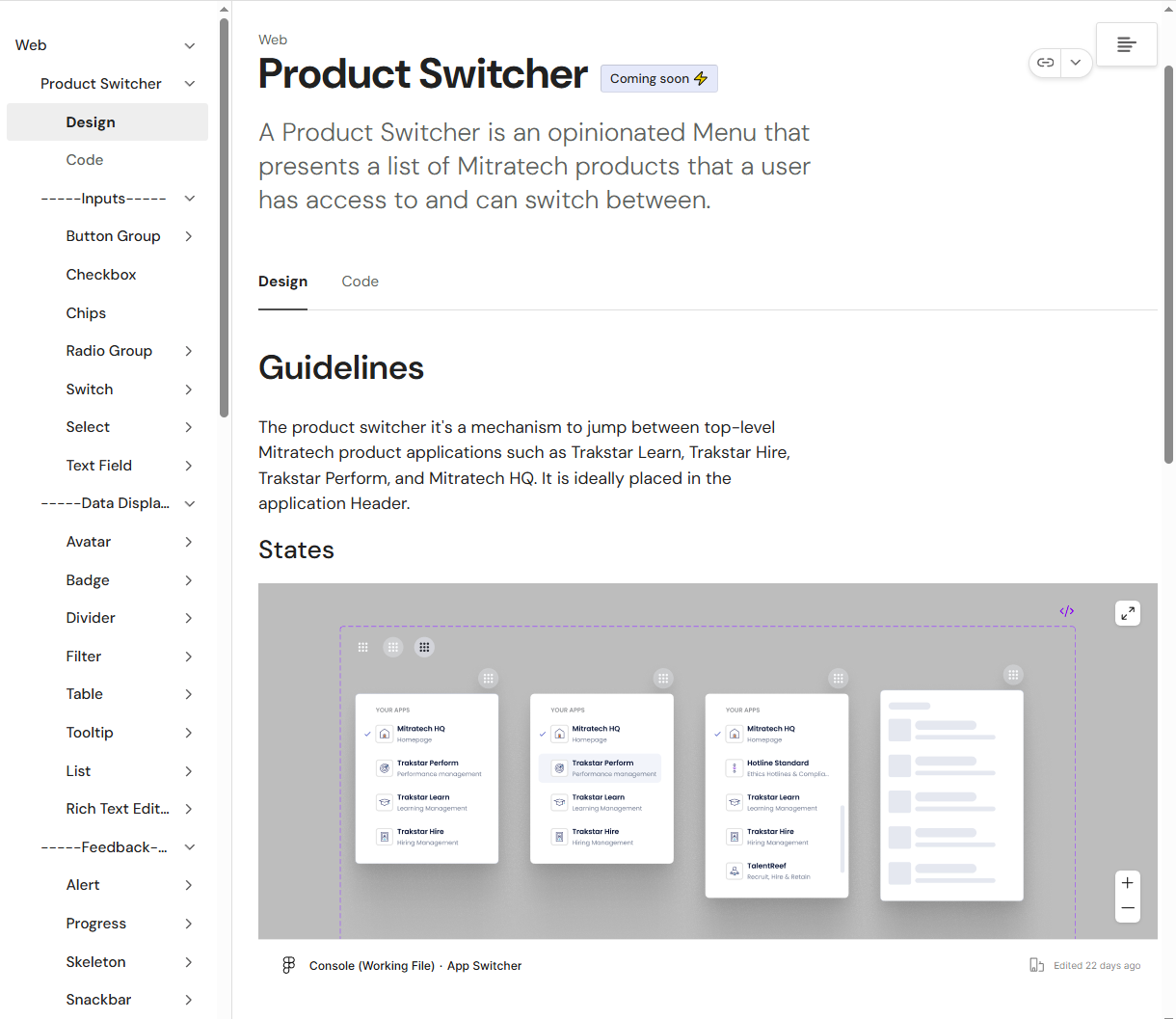
The fix was not more documentation. It was a fundamentally different relationship between the two disciplines. We introduced Zeroheight as a central repository where working code lived alongside its corresponding design components, so that the specification and the implementation occupied the same space rather than existing in separate tools that neither team was fully fluent in. Figma's component libraries handled the distribution side, pushing updates directly across products and cutting the rework that had previously accumulated every time something changed upstream. Designers could contribute production-ready components to the library themselves. The handover stopped being a handover. It became a collaboration.
What changed wasn't just the process. It was the dynamic. Engineers who had previously received designs as a finished argument to be interpreted started participating in the decisions that shaped them. Designers who had handed work over a wall and hoped for the best developed a fluency in the medium their work would ultimately live in. The gap between design and development, which had always been treated as an unfortunate fact of life, turned out to be a choice. We simply stopped making it.
Closing the Gap.
Every product organisation eventually faces a version of the same problem. The more capable your software becomes, the harder it is to use all of it. Mitratech's customers knew this intimately. They had invested in a suite of products that spanned HR compliance, risk assessment and legal operations. They valued what each one did. What they struggled with was the experience of moving between them. Users faced context switching, re-entering information, even losing the thread of a workflow every time a new tool demanded their attention. The capabilities were there. The coherence was not.
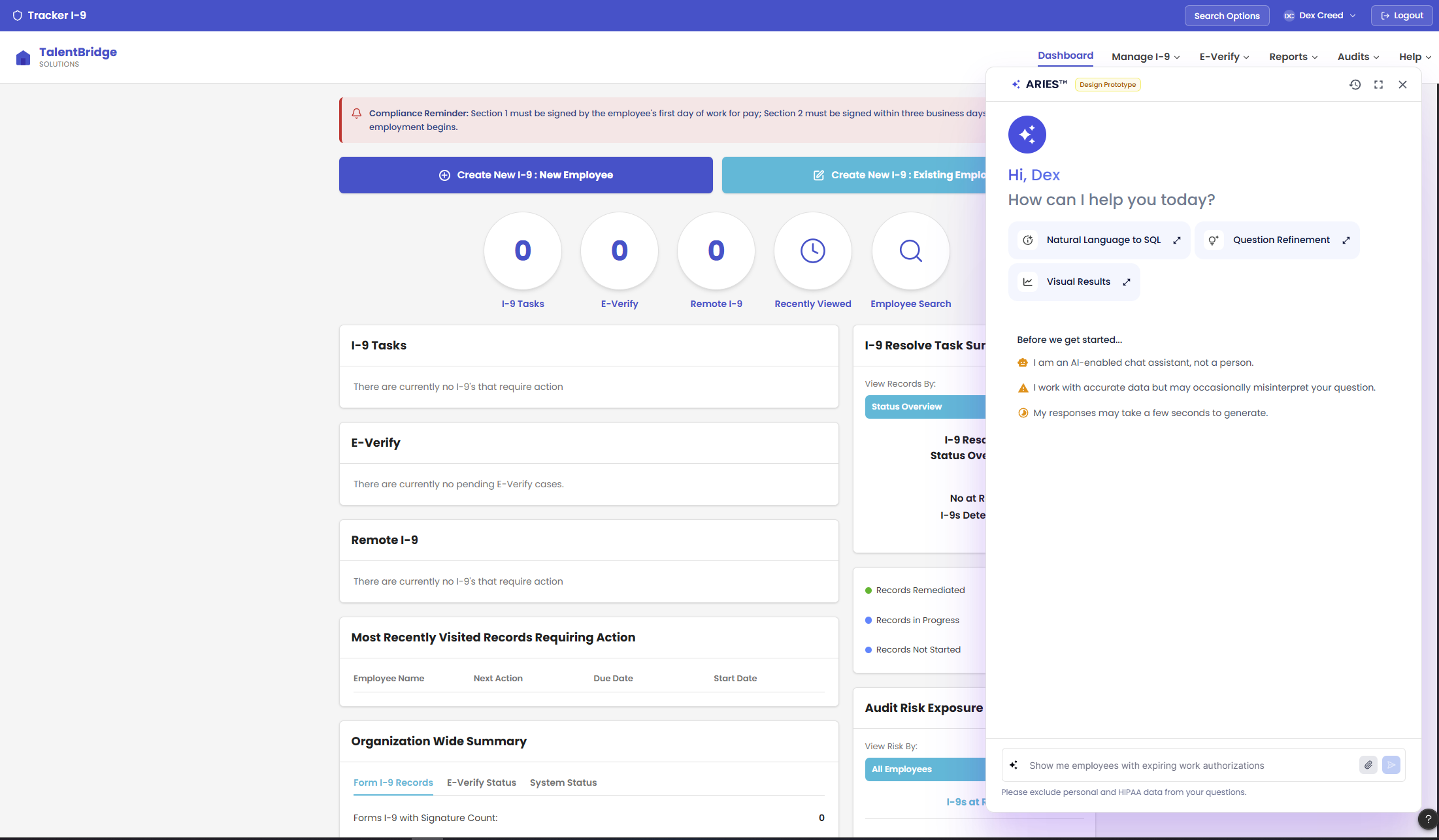
ARIES began as an answer to that specific frustration. The earliest proof of concept was a chat-bot that answered HR compliance questions by querying our internal database, bypassing users’ frequent manual searches for information. It was a small change in surface area with a large change in experience. Users noticed immediately. More importantly, so did we. If a single agentic intervention could reduce that much friction in one corner of the product, the same approach could work anywhere.
That realisation changed the scope of what we were building. ARIES evolved to become an embedded intelligence platform; a digital assistant that follows users across Mitratech's product suite, allowing them to ask HR compliance questions, initiate complex workflows and respond to risks and alerts in natural language, right in the flow of work. It does not ask users to stop what they are doing and navigate somewhere else. It meets them where they are, surfacing expert-written HR advisory content at the moment it is most relevant and acting as an orchestration layer between products that had previously had no common language.
The research process that shaped ARIES was as important as the product itself. We conducted discovery interviews across customer segments to understand not just where the friction was, but why it had persisted for so long. What we found consistently was that users had stopped expecting their tools to work together. The fragmentation had become invisible because it had become normal. Part of our job was to show them what a more coherent experience could feel like before they had the language to ask for it.
ARIES has since grown beyond its origins on the Platform team. It now defines the strategic vision for Mitratech's HRS and GRC business units, establishing a new model for how the company delivers intelligence and interoperability across its entire portfolio. What began as a response to a customer complaint became the architecture for a new way of thinking about what Mitratech's products could be when they worked as one.
The Intelligence Layer.
Innovation is easy to talk about. It is considerably harder to build into the way an organisation actually works. At Mitratech, I wanted to do the latter.
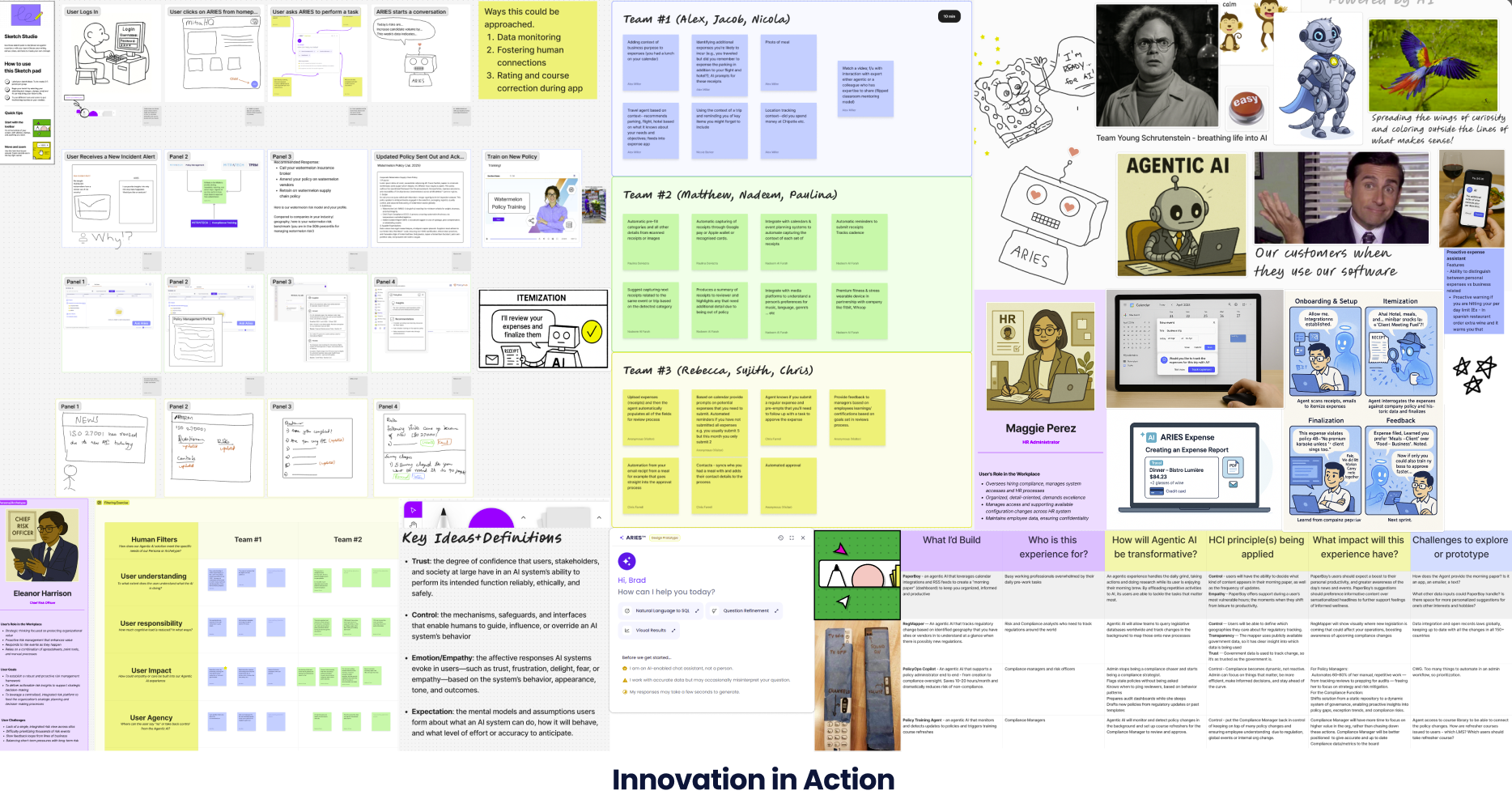
The Innovation Labs programme brought together voices from across the business: customer service, product management, design, engineering, sales and marketing. The workshops were structured around a simple premise: that the people closest to the product and the people closest to the customer rarely occupy the same room, and that the distance between them is where good ideas go to die. Closing that distance, even temporarily, tends to produce things that neither group would have reached alone.
The reviews were strong. More importantly, the habit took hold. People who had never thought of themselves as creative contributors started showing up to sessions with ideas prepared. The language of experimentation began spreading into conversations that had nothing to do with the workshops themselves. That, more than any individual output, was the point.
The outputs turned out to be remarkable anyway. The first hackathon produced the concept for ARIES Intelligence, a system that allowed customers to surface answers from Mitratech's proprietary database of expert-curated HR guidance directly through the ARIES assistant. Before it existed, customers waited weeks for a scheduled consultation with our advisory team. After it, they could ask their question in plain language, upload a document, and receive guidance drawn from the same expertise immediately. ARIES Intelligence has since evolved into a product-led strategy known internally as Content as a Service, opening new avenues for customers and partners that did not previously exist.
The second hackathon produced Mitratech LoA, a leave of absence management tool built around the reality that no two leave situations are identical. HR teams navigating leave requests face a legally dense framework, time pressure and frequently incomplete information. LoA uses ARIES to deliver step-by-step guidance drawn from a database maintained by Mitratech's legal experts and HR advisors, simplifying one of the most judgment-intensive tasks in HR operations. Less than nine months after the concept was sketched out in a hackathon, Mitratech LoA had become a product.
That turnaround is worth sitting with for a moment. From whiteboard to shipped product in under a year, twice. Not because the organisation moved unusually fast, but because the ideas that came out of those rooms were grounded enough in real customer problems that the path from concept to conviction was short. That is what a culture of curiosity actually produces. Not just ideas. Ideas that are ready to become something.