Maker to Multiplier.
There's a moment in every designer's journey when the craft stops being enough. Circa is where I learned to lead without losing the instinct that made the work good in the first place. Less doing, more enabling.
Some projects change the way you see your job. Diversity Catalyst was one of those.
Circa’s platform connected employers directly with community-based organisations to reach candidates who might otherwise fall through the gaps of a conventional hiring process. Our users spanned the full length of that connection: hiring managers, social workers, and job seekers looking for a fair shot in a market that didn't always offer one. When I arrived at Circa, nobody had ever formally asked any of them what the experience was actually like. There was no design department, no research practice, no process for listening. I built all of it from scratch.
Getting into those conversations changed what I thought my role was for. A well-crafted interface still mattered, but it was a means, not the end. The end was a social worker successfully placing someone who deserved the opportunity. A hiring manager finding the person who transformed their team.
I understood that most clearly over coffee with a disabled veteran of the US Coast Guard. She had spent several years on disability leave and used the platform I helped design to find her way back to work. She cried when she told me what it had meant to her. No brief I had ever received prepared me for what it felt like to hear her gratitude. Behind every user flow is a person with something real at stake, and that conversation made sure I never forgot it.
Product With Purpose.
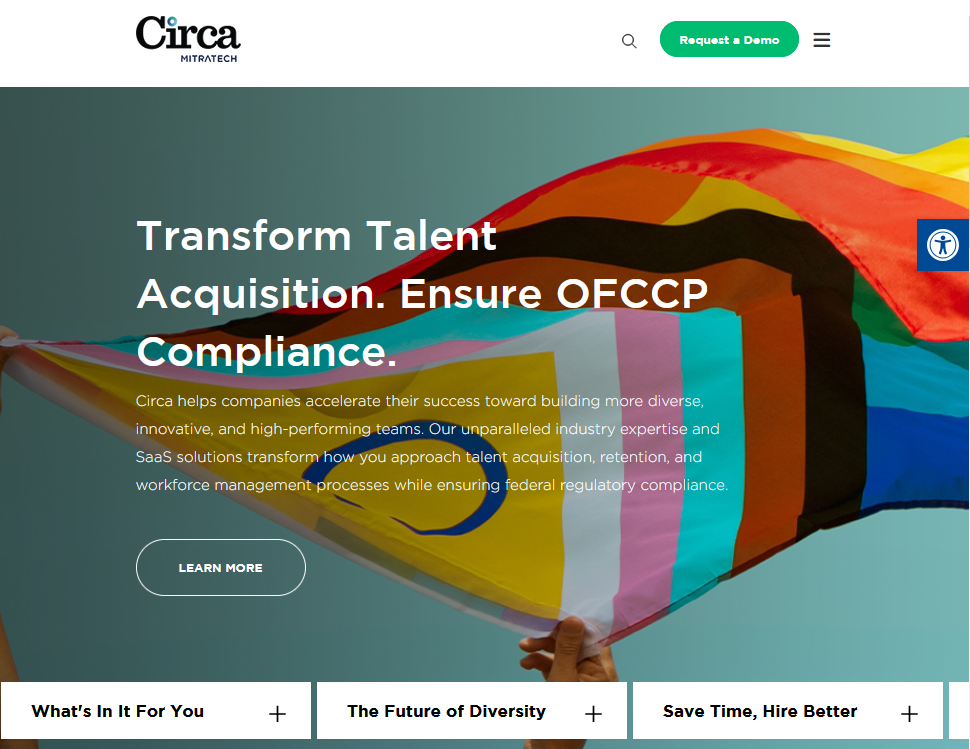
Diverse hiring doesn't fail for lack of intention. It fails for lack of infrastructure. At Circa, building that infrastructure became my work.
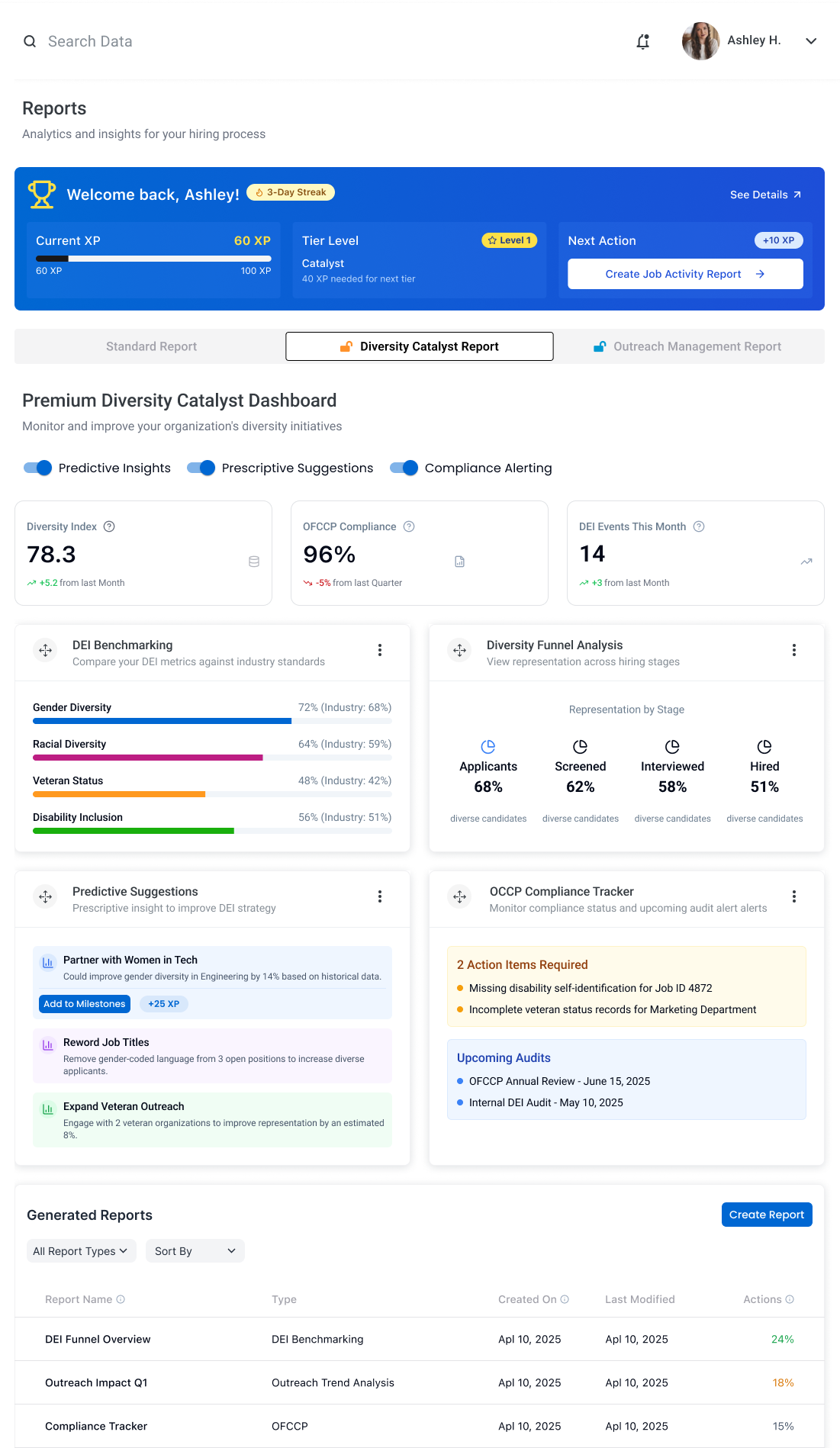
Hiring pipelines are less predictable than they appear. Applicant volumes shift with the seasons, with how a job description is worded, with the radius of a search. One of the first things I designed to address this was the Outreach Impact dashboard, a reporting tool that let HR teams track the effectiveness of their hiring strategies at a glance, spotting trends across applicant volume, description performance, and sourcing channels quarter over quarter. For the first time, our customers could see what was working and why.
The more interesting discovery came from listening. Circa had spent years building a content library of certified DEI guidance, seminars and written resources from some of the most respected voices in the industry. Our customers thought it was excellent. They also told me, consistently, that they had no idea how to apply it to their own job postings. The content existed. The connection to their daily work did not.
I designed a job description assistant that closed that gap, helping employers write postings optimised for local and online job boards while surfacing relevant articles and webinars from our own library as they worked. Usage of our guides and seminars surged in the months that followed. Users weren't discovering something new. They were rediscovering something Circa had always had.
That shift had consequences beyond the product. Content that sales and marketing had long treated as a secondary feature suddenly looked like something else entirely. It greenlit a net-new product, the Advanced Belonging and Inclusion Calendar, which opened a revenue stream that hadn't existed before. Research had changed what the business thought it was selling. That, for me, is what design leadership actually looks like.
Less Figma, More Vision.
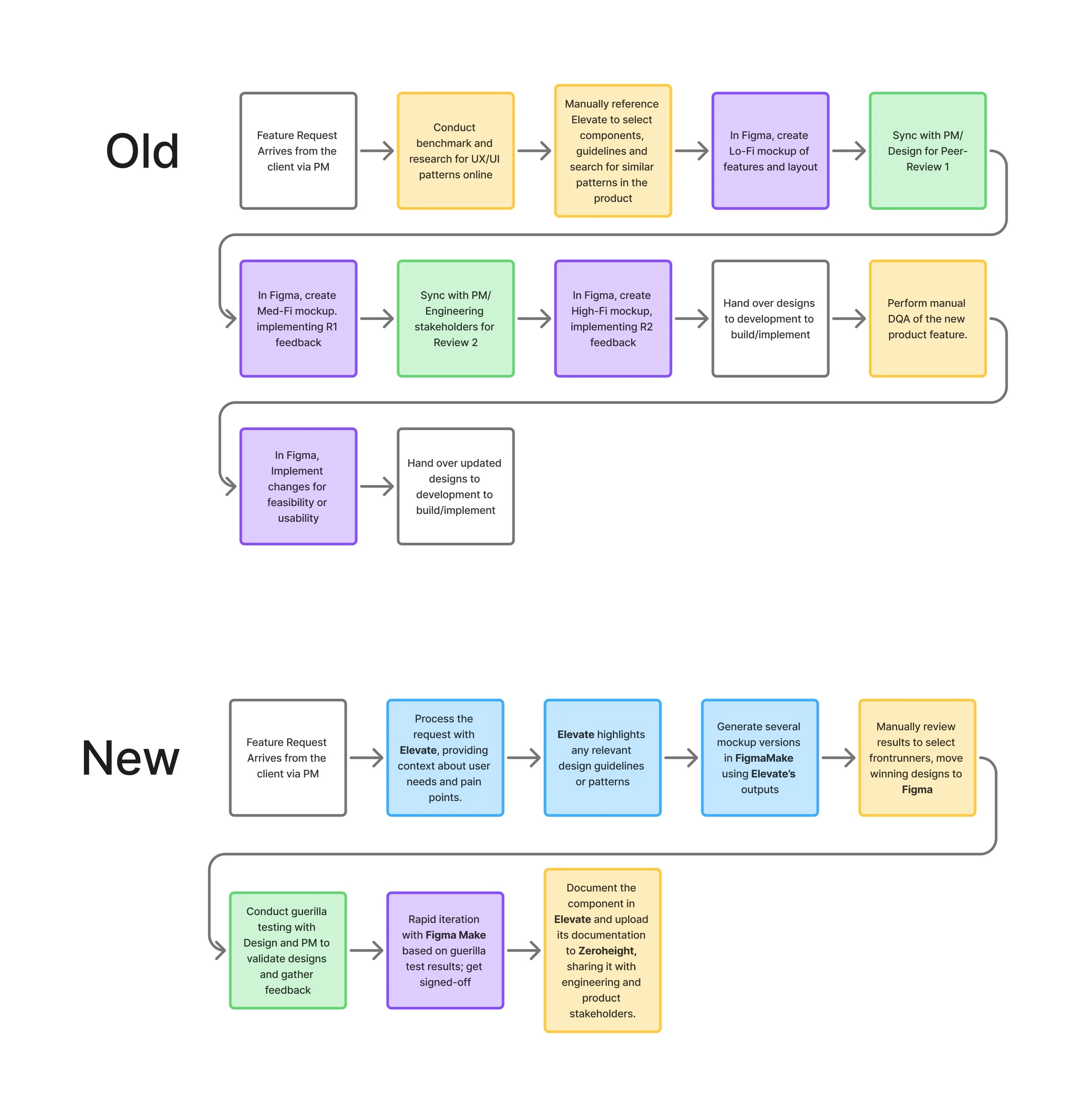
Innovation had become a dirty word at Circa. Not because people didn't care about building great products, but because the process of getting there had grown so slow and uncertain that proposing something new felt more like opening a can of worms than cracking open a door. Feature requests would arrive from a sales call or a research session full of promise, then disappear into a months-long cycle of mockups, stakeholder reviews and engineering validation before anything could be tested. By the time a idea had survived the process, the moment had often passed.
The problem wasn't the people. It was the sequence. Design was being asked to present fully-formed thinking to partners who hadn't been part of forming it, which made every review feel higher stakes than it needed to be. I introduced a new framework to change that. Designers began using an internal GPT to query our design system, personas and research repository before putting pen to paper, then created rough low-fidelity variants using rapid prototyping tools. These napkin sketches went straight to product managers and engineers for early, informal feedback. That feedback shaped the medium and high-fidelity work that followed, which could then be guerrilla tested with internal stakeholders before anything went through formal design review.
The resistance was immediate and understandable. Nobody wants their calendar filled with meetings to review work that isn't finished yet. What changed their minds was the experience of those early sessions. Engineers and product managers who had previously received designs in their “final form” found themselves shaping the direction of a feature in real time. Ownership replaced friction. The process that had once felt like a bottleneck started to feel like a conversation.
Concept to handoff, a process that had taken a month or more, began completing in under a week. Alignment between design, product and engineering improved because all three were present at every stage rather than handed off to one another in sequence.
A few months in, I walked into a conference room to kick off a new project and stopped in the doorway. Several engineers and product folks had arrived before me. They were already at the whiteboard, sketching, scribbling on notepads, running their own informal ideation session before the designer had even shown up. I smiled and found a seat. The methodology had escaped the design team entirely, which was exactly the point. Everyone is creative. Sometimes they just need a process that proves it to them.
The Method Matters.
In 2023, Circa was acquired by Mitratech, a software heavyweight whose divisions spanned HR compliance, risk assessment, and legal technology. On paper it was good news. In practice it was terrifying.
The mission-driven culture of Circa had shaped the way I worked. I had built something there, a team, a process, a design practice with a point of view, and the prospect of absorbing all of that into a much larger organisation raised questions I couldn't immediately answer. Would there be room to do meaningful work? Would the things I had built survive the transition? The anxiety was real, even as the opportunity was obvious. Mitratech offered a product surface I had never encountered before, and users I had never designed for. That was exciting, and if I was honest with myself, it was also overwhelming.
My first move was the same one I always make. I opened the design system and started reading. I catalogued the patterns and assets the existing team relied on, noted the questions I had and the areas I thought could be stronger, and mapped where I could have the greatest impact quickly. Then I went looking for the people. I studied the user personas relevant to the projects I'd be inheriting, getting to know the humans on the other side of the screen before I put a single frame in Figma.
Circa's design vertical was fully absorbed into Mitratech's product organisation, which meant I arrived with one colleague from the acquisition and a mandate to build. Within a year the team had grown to eight, with designers recruited from India, South America, and the UK. I had always believed that diverse teams make better products. Here was the chance to prove it.
Six months after the acquisition, at a company all-hands, senior leadership reviewed what the new HR design team had shipped. The surprise on their faces was visible. The team was brand new, the product surface was unfamiliar, and the output was substantial. What I knew, and they were only beginning to understand, was that the process did the heavy lifting. The same rapid prototyping framework, the same research-first approach, the same habit of involving product and engineering early that had transformed how Circa worked, travelled with me into Mitratech and took root just as quickly.
Circa entered the acquisition as the largest company Mitratech had ever bought, and arrived as the second-largest revenue driver in the business overnight. It brought new customers, new credibility, and a new frontier in DEI hiring that Mitratech hadn't been able to reach before. It also, quietly, brought a new way of working. The processes I had introduced at Circa became standard practice across the design organisation. My approaches to hiring and talent assessment replaced what had existed before and remain in use today. Sometimes the most lasting thing you can contribute to a new place is the way you taught it to think.